Investing in Container Shipping: Factors to Be Aware of
Choosing the right type of container, and implementing the right process for your shipping needs, can be a daunting prospect. There are numerous factors to consider beyond simply selecting the most effective container option. Businesses also need to be aware of:
Container Weights and Road Limits
The weight of a container can vary drastically, and it’s something businesses must account for when shipping products. Each country has its own restrictions regarding the weight of containers. For instance, in the US, the general limit is 80,000 lbs (36,287 Kg) gross vehicle weight (GVW) for each vehicle. The limit applies to the full weight of the truck, container, products, and chassis.
Aside from the gross vehicle weight limit, companies must ensure vehicles don’t exceed individual axle load limits. Overweight trucks can lead to penalties, fines, and additional costs for unplanned transport, as well as load distribution and handling. Contact the local office in your shipping destination if you’re unsure about weight limitations.
Number of wine, beer or spirits’ pallets per container
Containers offer a convenient way to ship large amounts of wine, beer or spirits at once. However, the quantity of pallets that can be added to a container will depend on numerous factors. Available floor space, loading configuration and pallet size are all essential factors, as well as road weight limits.
The format depends on the destination country too. For example, the common domestic format for shipping wines in the US is around 12 bottle cases of 750 ml bottles, rather than the 6 bottle cases available elsewhere. This can impact your warehouse pricing, and how you organize your shipments. Additionally, while pallets come in standard sizes, their availability varies depending on your collection location.
Packaging Options
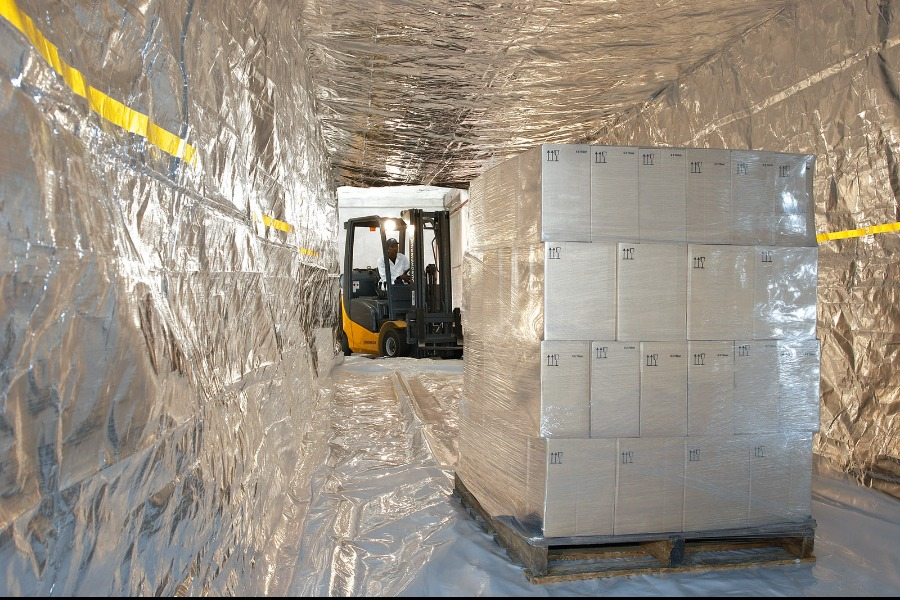
Wine, beer and spirits can be packaged for container shipping in a variety of ways. One of the most common methods is to ship alcoholic beverages on pallets made of wood or plastic. Most of these pallets measure 1 meter by 1.2 meters in the US, compared to 0.8 meters by 1.2 meters in Europe.
The bottles are often stacked four layers high, and you can typically load up to 56 cases of wine, beer or spirits per palette. Outside of pallet options, companies can also consider using loose loading methods. Non-palletized, or loose-loaded alcoholic beverages are often shipped on a slip sheet.
VGM
The Verified Gross Mass or “VGM” of your products will also be a crucial consideration. VGM refers to the full weight of your wine, beer or spirits’ products, covering dunnage and bracing, and the tare weight of your container. SOLAS guidelines require shippers to provide VGM details in a shipping document before a vessel is loaded. Any container without VGM details can be rejected for shipping.
This means companies need to ensure they’re accurately calculating their VGM and providing the right documentation to regulatory bodies throughout the shipping process.