• Careers
  • Sailing schedules
  • Track a shipment
  • Locations
  • Language selector English
    • Language selector English
      • English
Navbar
Get a quote
Log in
  • Services
    • Packaged beverages
      • Full container loads (FCL)
      • Less-than-container loads (LCL)
      • eShipping
      • Temperature control
      • Cargo insurance
    • Bulk transport
      • Flexitanks
      • ISO tanks
      • Dry bulk liner
    • Transport options
      • Sea Freight
      • Road transport
      • Rail transport
      • Air Freight
    • Supply chain services
      • Control tower
      • Supply chain management
      • Warehousing
      • Customs services
      • GoGreen Plus
  • What we transport
    • What we transport
      • Wine
      • Beer
      • Spirits
      • Non-Alcoholic beverages
      • Beverage packaging
      • Beverage ingredients
  • Tools & support
    • Tools & support
      • Get a quote
      • Find schedules
      • myHillebrandGori
      • Carbon calculator
      • Track a shipment
      • Customer login
  • Insights
    • Insights
      • Port updates & disruptions
      • Trade lane insights
      • Blog
      • Knowledge center
      • Customer Stories
      • FAQ
      • Glossary
  • Company
    • Company
      • About Hillebrand Gori
      • Sustainability
      • Locations
      • Press releases
      • Careers
    • Locations
    • Contact us
    • Log in

Share this post

Insights and knowledge

FOB incoterms®: what everybody should know about them

Table of contents
  • Incoterms® explained
  • What are FOB incoterms®?
  • Other types of incoterms®
  • Incoterms® are designed to help

Shipping goods internationally involves many different stages, each with its own costs and risks. Incoterms® (otherwise known as “international commercial terms”) clarify with whom the responsibility for the shipment sits with for each step of the process, so that the legal obligations are understood and agreed from the outset. The FOB (free on board) incoterm® is one of the most common terms of sale used and is described in more detail here.

Incoterms® explained

The International Chamber of Commerce (ICC) defines the incoterms® regarding the responsibility and liability involved with domestic and international shipping. These rules cover three specific areas:

  1.  Transfer of risk

  2. Transfer of cost

  3. Obligations of the seller and the buyer

Incoterms® are also always associated with a named place. This will be either the “place of delivery” or “place of destination”, depending on which particular set of rules is used. Where a “place of delivery” is used, the risk transfers from the buyer to the seller at that point. However, the “place of destination” is the ultimate destination of the transported goods.
The main advantage of implementing incoterms® right from the beginning of any transport activity is that it clarifies the roles and responsibilities at each stage of the process. This means that accurate quotes are created and any potential misunderstandings are avoided. Ultimately, this helps the freight movement to proceed smoothly and efficiently, which benefits both the buyer and the seller.

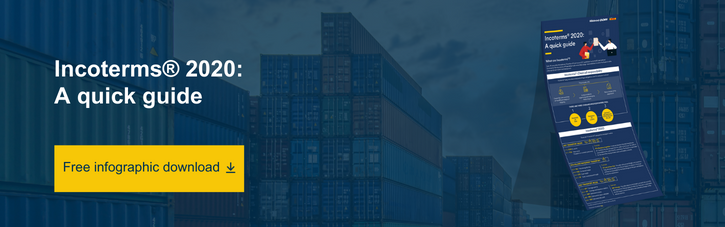
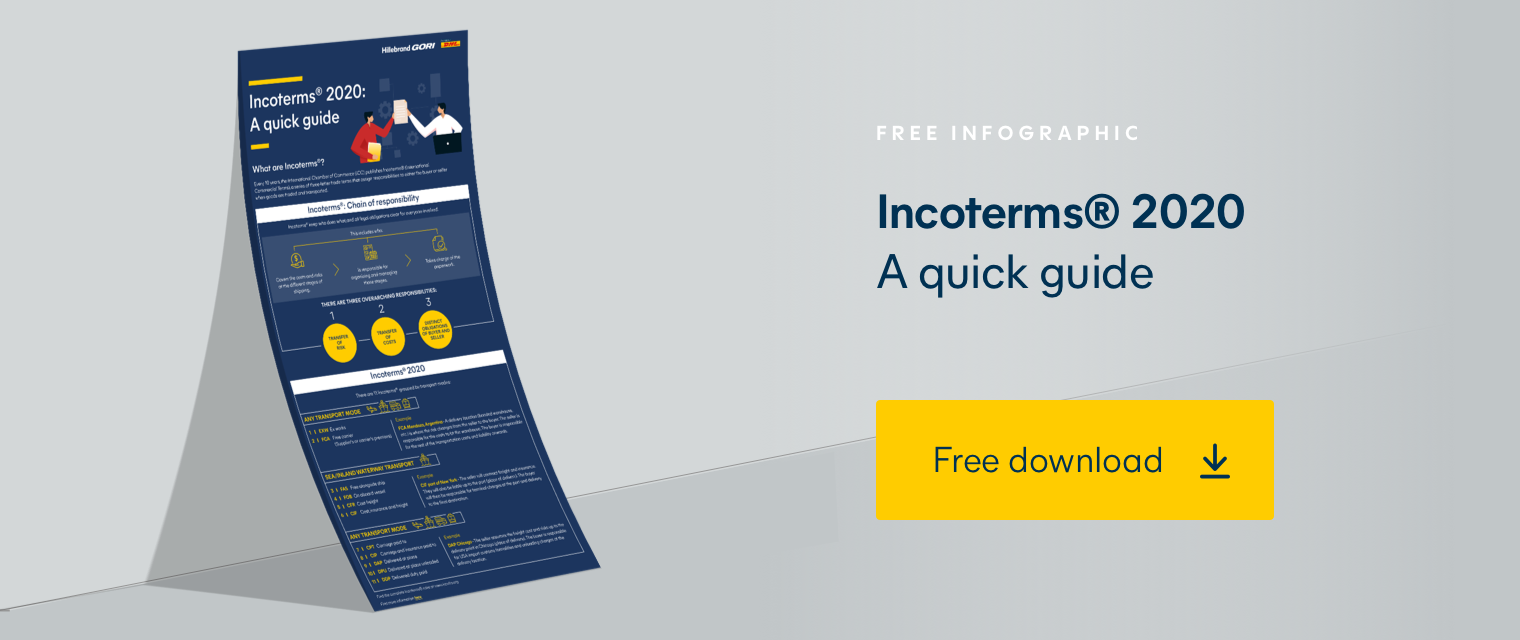
The ICC releases new rules every 10 years, with the most recent changes occurring in January 2020. A description of the updated rules is available in our guide to incoterms® 2020.

What are FOB incoterms®?

These are one of the most common types of rules in place for transport by sea/water. As the FOB (free on board) name suggests, here the risk is passed onto the buyer at the point when the goods have been loaded onboard a vessel.

More specifically, when using FOB terms, the responsibility for costs is borne by the seller in the following areas:

  • Loading the goods at the supplier’s premises

  • Transport to the first carrier

  • Export customs formalities

  • Origin terminal charges

  • Loading onto the vessel

Conversely, the buyer is responsible for the costs associated with:

  • Main transport

  • Destination terminal charges

  • Import customs formalities

  • Delivery to the destination

  • Unloading charges

An important point to note is that no insurance is included in FOB incoterms®. Therefore, this needs to be purchased through the freight forwarder or a third-party provider.

Other types of incoterms®

There are many different types of incoterms®, with each one being designed to suit a specific circumstance. Some rules are applicable to all modes of transport, but others are only relevant for transport by sea/water. Examples of incoterms® include:

  • EXW (Ex works): the buyer takes on the risk at all stages of transport.

  • FAS (free alongside ship): the risk is transferred alongside the ship, meaning that the buyer is liable for loading onto the vessel and all subsequent costs.

  • CFR (cost freight): the risk is transferred onboard the vessel, with the seller taking on the responsibility for the cost of main transport.

  • DAP (delivered at place): the seller takes on additional costs, including delivery to the destination.

This is just a small selection of the incoterms® that are available. For a more detailed description, please see our summary of incoterms®.

Incoterms® are designed to help

Incoterms® play a vital role in ensuring the smooth shipment of freight worldwide. There is a wide range of different rules available to suit all requirements, such as FOB incoterms® when moving freight by sea/water. These rules clarify the responsibility and liability of the buyer and the seller at each stage of transport, helping to avoid confusion and disagreements.

To find out how we can help with FOB incoterms® (and others) for your shipments, please contact our team.
May 13, 2022
Article - 28 Jul 2026
 
US alcohol import tariffs: A guide for wine, beer and spirits importers
Read the article
Insights and knowledge
Article - 11 Feb 2026
 
How data-driven insight supports better supply chain performance for wine, beer and spirits importers
Read the article
Insights and knowledge
Article - 5 Nov 2025
 
The people behind the process: Carole's story
Read the article
Insights and knowledge
How can we help your business grow?
Get a quote
  • Services
  • Packaged beverages
  • Bulk transport
  • Supply chain services
  • Transport options
  • What we transport
  • Wine
  • Beer
  • Spirits
  • Non-Alcoholic beverages
  • Beverage packaging
  • Beverage ingredients
  • Tools & support
  • Get a quote
  • Find schedules
  • myHillebrandGori
  • Carbon calculator
  • Track a shipment
  • Customer login
  • Insights
  • Port updates & disruptions
  • Trade lane insights
  • Blog
  • Knowledge center
  • Customer Stories
  • FAQ
  • Glossary
  • Company
  • About Hillebrand Gori
  • Locations
  • Sustainability
  • Press releases
  • Careers
  • Terms of use
  • Privacy and cookie policy
  • Impressum
  • Terms and conditions
Logo DHL